

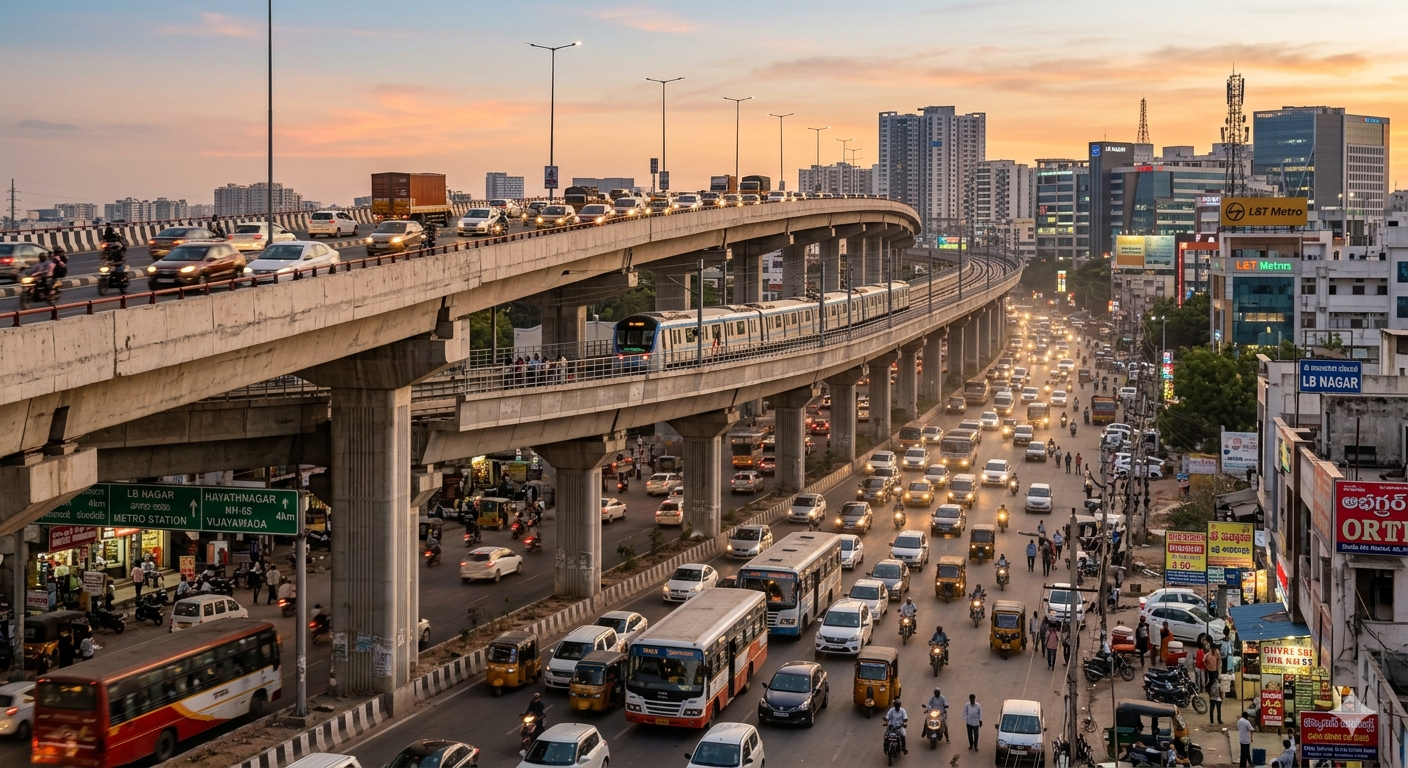
₹941 Crore Double-Decker Corridor Between LB Nagar and Hayathnagar
Hyderabad, one of India’s fastest-growing metropolitan regions, is preparing for another major transport upgrade.
Telangana has announced a ₹941 crore double-decker elevated corridor between LB Nagar and Hayathnagar along the busy NH-65 stretch, a move expected to significantly ease congestion and improve connectivity for lakhs of residents.
Hyderabad Double-Decker Corridor Overview

Telangana Roads and Buildings Minister Komatireddy Venkat Reddy announced a ₹941 crore double-decker elevated corridor connecting LB Nagar and Hayathnagar, aimed at reducing severe traffic congestion along one of Hyderabad’s busiest commuter corridors.
The project will be financed through a joint contribution from the central and state governments, with the Centre allocating ₹741 crore and the state government contributing ₹200 crore.
The proposal, submitted earlier this month, has already secured approval from the Centre, while the tendering process is likely to commence within the next six months
Why This Corridor Matters
The LB Nagar–Hayathnagar stretch has long been one of the busiest transport arteries in eastern Hyderabad.
Serving as a critical gateway connecting residential zones, commercial areas, and intercity highway movement, the corridor handles thousands of daily commuters, public transport vehicles, freight movement, and private traffic.
As urban expansion intensified across Vanasthalipuram, Hayathnagar, Abdullapurmet, and surrounding areas, congestion became a daily challenge.
Peak-hour delays, bottlenecks, and inconsistent travel times turned routine commuting into a significant burden.
The new elevated corridor aims to address exactly that.
Project Highlights
Key Features of the Double-Decker Corridor
- Project Cost: ₹941 Crore
- Location: LB Nagar to Hayathnagar stretch on NH-65
- Length: Approximately 5.5 Kilometers
- Coverage: Expected to benefit nearly 12 lakh residents
- Impact Zone: Around 70 residential colonies
- Primary Goal: Reduce congestion and improve travel efficiency
The “double-decker” design is particularly significant.
View this post on Instagram
Rather than conventional road widening—which is often limited by land constraints in dense urban zones—the elevated structure allows layered traffic movement, optimizing vertical space in an already crowded corridor.
This model has increasingly become the preferred solution in fast-growing Indian cities.
Beyond Traffic: The Real Estate Effect
Infrastructure projects rarely affect transport alone.
They reshape land value, business potential, and urban migration patterns.
Hayathnagar has already emerged as a strong residential growth zone due to its connectivity, affordability, and access to the Outer Ring Road. With the announcement of the elevated corridor, market attention has intensified further.
Developers are closely watching the area for:
- Plot investments
- Villa projects
- Apartment launches
- Commercial frontage development
Improved mobility often translates directly into rising property demand. For many investors, roads are not just roads—they are economic signals.
Challenges Ahead
Large-scale infrastructure projects also come with practical and administrative challenges.
Among the concerns are:
- Construction-phase traffic disruptions
- Land acquisition complexities
- Budget execution and cost escalation
- Timely completion and project management
- Environmental and urban planning considerations
Residents often welcome the long-term benefits while remaining cautious about short-term inconvenience. The success of the project will depend not only on engineering but on execution discipline.
A City Building Upward
Hyderabad’s infrastructure strategy increasingly reflects a broader urban reality: horizontal expansion has limits.
As population density rises and mobility demands grow, cities must build upward—through flyovers, elevated corridors, metro systems, and multi-layered transport networks.
- The LB Nagar–Hayathnagar corridor fits into this larger philosophy.
- It is not simply a traffic solution.
- It is part of Hyderabad’s transition from expansion to optimization.
- That distinction matters.
Because modern cities are no longer judged only by how fast they grow—but by how intelligently they move.
The Human Side of Infrastructure
For a daily commuter, a 30-minute reduction in travel time means more than convenience.
It means:
- More time with family
- Lower fuel expenses
- Reduced commuting stress
- Better work-life balance
- Improved public transport efficiency
Infrastructure debates often focus on numbers. But ultimately, their success is measured in ordinary lives. And in Hayathnagar, that is where the real story lies.
1 Comment
Pingback: Hayathnagar HMDA Master Plan 2031: A Blueprint - hayathnagarnews.in