

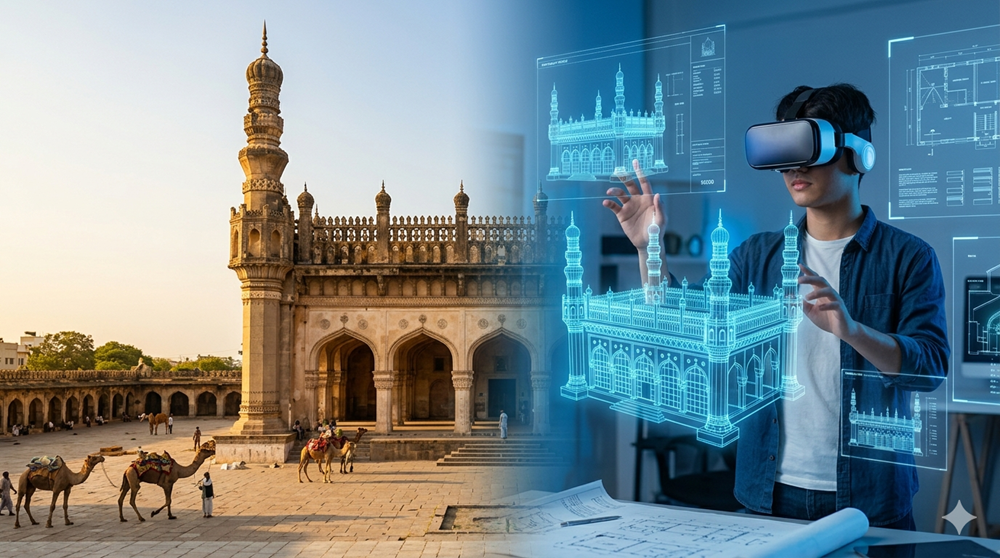
Hayathnagar, once a 17th-century architectural triumph, has been reimagined for the modern era through virtual reality, theater, and meticulous restoration.
This article celebrates the history and heritage: the story, people, and landmarks that have shaped Hayathnagar over time.
From discussing what has been documented in the history of figures like Hayat Bakshi Begum to lesser-known local contributors, which will be covered soon, this article highlights the cultural roots, traditions, architecture, and historical milestones that define a community’s identity.
It preserves both grand narratives and everyday legacies, connecting the past with the present.
For a long time, Hayathnagar was considered the outskirts of Hyderabad, even up to the early 2000s. Its real growth didn’t happen all at once—it picked up gradually.
When did momentum start?
The area began gaining noticeable momentum around 2005–2010, and growth accelerated further after 2010.
Why did it grow during this period?
- Expansion of Hyderabad city limits: The formation of Greater Hyderabad and rapid urban spread pushed development outward
- Improved road connectivity: The Vijayawada Highway (NH-65) made Hayathnagar more accessible
- Real estate boom: Land was cheaper compared to central Hyderabad, attracting builders and homebuyers
- Spillover from nearby areas like LB Nagar, which was already developing
After 2010
- More residential layouts, apartments, and schools came up
- Infrastructure slowly improved
- It started transitioning from a “far area” to a recognized suburb
In the sprawling landscape of the Deccan, few historical sites capture the intersection of visionary urban planning and artistic brilliance quite like Hayathnagar.
Established in the 17th century near Hyderabad, this planned township was far more than a simple royal project; it was a sophisticated hub of community life and regional stability.

While the era was defined by shifting political power, the physical foundations laid at Hayathnagar offered a sanctuary of rest, prayer, and commerce that outlasted the very dynasty that created it.


What History Says About Hayathnagar
Hayathnagar is not just a modern suburb—it has roots going back to the 17th century during the rule of the Qutb Shahi dynasty.
History tells us that Hayathnagar started as a royal project built by the then-powerful queen Hayat Bakshi Begum, served as a resting and trading point, stayed a quiet village for a long time, and finally grew into part of modern Hyderabad.
Royal connection
Hayat Bakshi Begum, one of the most influential women of the Deccan. She developed this region as a resting and settlement zone outside the main city of Golconda/Hyderabad.

- She was born into a royal family and learned how to manage political affairs from a young age.
- She married her cousin, Sultan Muhammad Qutb Shah, which placed her at the center of power. After his death, she took charge of the kingdom for some time because her son was still young.
- She is remembered for keeping the kingdom stable during difficult times.
- It is said that when the Mughal emperor Aurangzeb laid siege to Golconda, she played an important role in handling the situation and helping to maintain peace.
- Her decisions helped the kingdom remain independent for many years.
- Because she was both a strong leader and someone who cared for her people, she earned the name “Ma Saheba,” which means a respected and caring mother.
A planned settlement
History suggests that Hayathnagar was not random—it was intentionally developed:
- A grand mosque (still standing today)
- Water sources like wells and stepwells
- Sarais (rest houses) for travelers
These features made it a self-sustaining stopover for people traveling across the Deccan.
Strategic location
Hayathnagar lay along important travel routes connecting the following:
- Golconda / Hyderabad
- Eastern parts of the Deccan
Because of this, it became a transit hub for traders, soldiers, and travelers.
After the Qutb Shahi period
Following the decline of the dynasty, the area
- Lost royal attention
- Continued as a small rural settlement for centuries
- Retained its identity mainly through the mosque and local memory
Transition to modern times
Only in recent decades did Hayathnagar
- Re-emerge due to Hyderabad’s expansion
- Transform from a quiet village into a growing suburb
A Masterpiece of Urban Planning
Built in the distinctive Qutb Shahi lime-and-mortar style, the township was anchored by a grand mosque and a massive caravanserai complex.
This wasn’t just an aesthetic choice; it was a strategic urban hub designed to accommodate the flow of people and ideas through the Deccan.
- The Grand Mosque: Completed in 1672 CE, this structure remains a centerpiece of Indo-Persian design, showcasing the artistic heights of the era.
- The Caravanserai: A specialized rest house for travelers, demonstrating that Hayathnagar was intended as a welcoming sanctuary for merchants and pilgrims alike.
- Structural Integrity: The use of traditional lime-and-mortar has allowed these structures to survive centuries of environmental wear, a feat of medieval engineering.
- In 2019, the Indian Institute of Technology Hyderabad launched a 360-degree virtual-reality project to allow modern audiences to explore Begum Hayat Bakshi’s world.
- It was a 360-degree VR animation experience / film trailer titled
“Ma Saheba—The Queen of Hyderabad.” Here is the link for news covered by IndiaToday. - The project aimed to translate oral historical narratives into immersive VR storytelling, letting viewers “step inside” history.
- It focused on Hayat Bakshi Begum, a powerful figure who influenced three generations of the Qutb Shahi dynasty
- In 2023, theatre productions like Savaan-e-Hayat, a Mohammad Ali Baig sequel to the much-acclaimed spectacle ‘Quli: Dilon ka Shahzaada,’ is based on the life of Hayat Bakshi Begum, dramatizing her life and highlighting her role as one of the most influential women in medieval Indian history
Why Hayathnagar Matters Today